Field record
Seven years on LUMIX
GH5, GH6, GH7

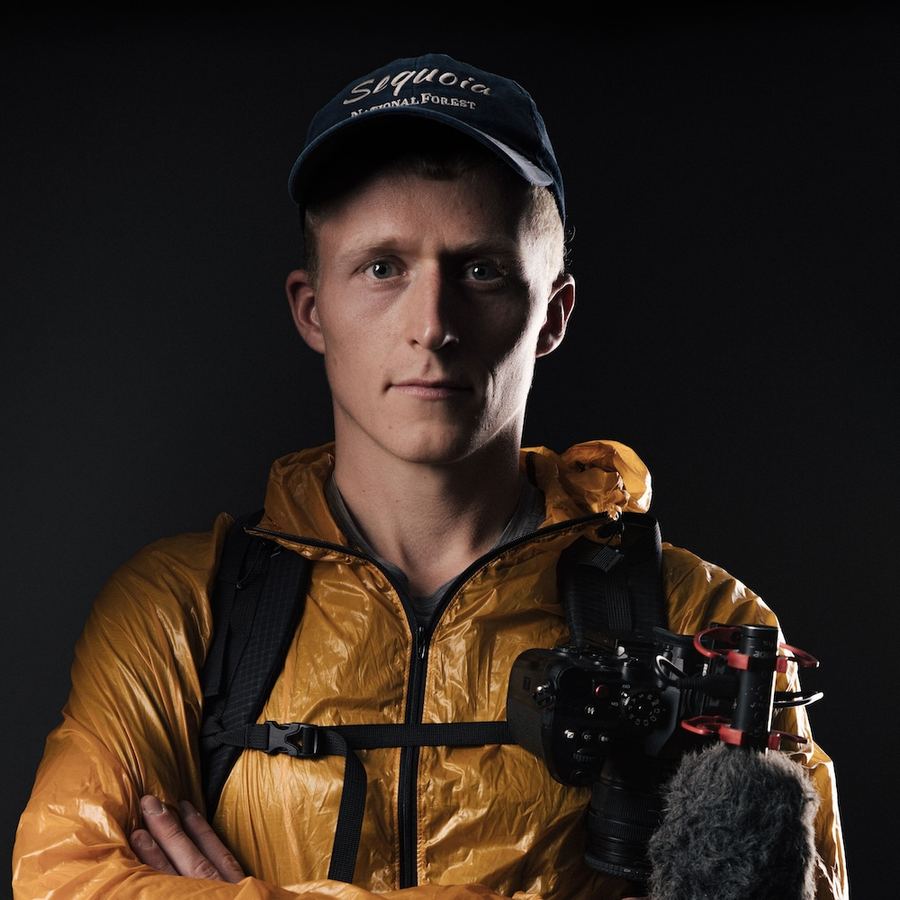
I make cinematic films in some of the most remote places on earth. Alone, on foot, carrying everything for weeks at a time, with no crew and no second body. Four days of unbroken rain on the Manaslu Circuit. Minus thirty in the Canadian winter. Forty-nine degrees in the Utah desert. Salt spray on tropical Pacific beaches and total humidity in the mountains of Taiwan.
Every frame of every one of those films was shot on a LUMIX. GH5, then GH6, now the GH7. Only the drone footage comes from anything else. Nobody watching them knows that.
The link that does not exist
Across 49 million views, nothing in any of my films says what shot them.
No camera credit. No gear list on screen. No brand anywhere in the work. People watch these films as cinema and assume cinema glass, and Micro Four Thirds gets none of the credit for any of it.
Every frame was shot on a GH5, a GH6 or a GH7.
In March 2026 Panasonic's imaging business said Micro Four Thirds "is not on the sidelines." Since then the LUMIX line has shipped five full-frame products and no new Micro Four Thirds body.
This is 49 million views of work that contradicts what people assume about the format, and the association has never once been made. The films exist either way. The link is the only part of this that is not already yours.
At a glance
The operating range
Panasonic publishes freeze-resistance down to -10°C. I have published films shot at -30°C and at 49°C.
A 79-degree working window against a 10-degree claim, on bodies bought off the shelf and carried on foot. Every line below is a film anyone can go and watch.
Ojos del Salado is the highest volcano on earth, and the Atacama approach to it is days of blown dust at altitude. River fords, storm camps and snow detours are documented across the short-film catalog as well. Two more are still in post: four days of unbroken rain on the Manaslu Circuit, where I dried the lenses every night to keep filming, and salt spray on tropical Pacific beaches, which put salt onto the sensor and into the buttons.
How it gets used
The camera is not in a bag. It rides on a chest harness, exposed, for the whole walk. It takes the rock on every scramble and every squeeze through brush, and it goes down when I go down. It has been carried chest-deep through river crossings and held into moving water to get the shot. It has been on ridges in wind strong enough to shift a loaded tripod.
Lenses get swapped on the trail, in rain, in blowing sand and in falling snow, with wet or frozen hands, because waiting for better conditions means losing the shot. Batteries get changed with fingers that have stopped working properly. Trail dust goes wherever it wants. The camera gets set straight into snow, mud and river gravel, because that is where the shot is.
It comes off the chest and back on thirty or forty times a day, pressed under a pack strap in between, covered in sweat and sunscreen. At night it goes into a wet tent. In the morning it comes out of a frozen one and straight into the sun, condensation and all.
Then it does the same thing again the next day, for up to three weeks with no resupply, no mains power, no dry room and no second body.
Ninety-five days on trail in 2025. Eight to ten projects a year. 53 TB of footage recorded and 48 hours of finished film published. There is no take two on a mountain I walked eleven days to reach.
Seven years of wear
Seven years of this leaves marks. Salt from the Pacific worked its way onto the sensor and into the buttons until some of them stopped responding. The power button eventually snapped off the body. A screen died after a fall. The 3.5 mm audio input failed. Lenses have been dropped and broken.
None of it ever stopped a film. I remapped whatever buttons still worked, dried whatever was wet, and kept shooting.
In seven years I have never lost, delayed or reshot a project because of a camera. Not one film has been published late because of one.
I am not careful with this gear. I push it until something gives, and then I keep filming.
In the field


Where the footage comes from
The four best-performing films, by lifetime views. Every frame of every one of them was shot on a LUMIX.
| Film | Region | Views | Hours watched |
|---|---|---|---|
| 16 Days of Silent Hiking in Nepal near Mount Everest | Himalaya | 3,459,862 | 865,133 |
| Yosemite's Hidden Wild | Sierra Nevada | 3,239,740 | 437,489 |
| Silent Hiking the John Muir Trail for 21 Days | Sierra Nevada | 3,060,374 | 1,239,853 |
| Solo Hiking 115 km in the Pyrenees | Europe | 3,003,314 | 403,939 |
Also in the top twenty: the Wild Rockies, New Zealand, the Dolomites, the Tour du Mont Blanc in winter, Madeira, Norway, Taiwan, Jordan, Patagonia, the Drakensberg and Lesotho, the Balkans, Scotland and the Annapurna Circuit. Six continents, one camera system.
Who watches it, and what it was shot on
Not phone viewing
88.1% of all watch time happens on a television, where the average viewer stays 23 minutes and 21 seconds. Phones account for 2.5% of the hours watched. The footage is judged on a large screen, by people who chose to sit down with it.
Where the audience is
Across the last ten films, 40.4% of views come from North America and 25.1% of the catalog from Europe. The United States alone is 36.7% of a recent film. Japan, South Korea and Taiwan together are a further 8% of recent viewing.
The kit
| Bodies | GH5, then GH6, now GH7 |
| Primary | LUMIX G Vario 14-140mm |
| Wide | LUMIX G Vario 8-18mm, LUMIX G 9mm F1.7 |
| Long | LEICA DG Vario-Elmar 100-400mm |
Shot, graded, mixed and cut by me. Every film goes through the same grade and the same sound pass, which is why a seven-year catalog shot on three different bodies still looks like one body of work.
See it, and take it with you
Every film title in the tables above links straight to that film.